Thursday, March 17, 2016
Spot Poem
I walk down the black path going to my spot. I see a squirrel run away from me and scurries up a tree.I cut through the dead grass to get to the steep side of the creek so i can jump to my spot. I jump down from the dead grass landing onto the wet sand. My hands are now sandy and there are hand prints in the sand. I walk over to the spot that i always sit at. The tide is a bit high this time so i sit up the bank. I look into the water and its quite clear. I see a leaf floating down the stream and a minnow follow the leaf. I want to go catch the minnow but its 30 degrees and i would freeze to death. I can still hear the cars on the road so that distracts me from the birds talking to each other. I look at the time and its 3:55 so I pop up and run back to campus making prints in the sand.

Friday, March 11, 2016
Callophrys hesseli (Hessel’s Hairstreak)
Kingdom: Animalia (Animals)
Phylum: Arthropoda (Arthropods)
Subphylum: Hexapoda (Hexapods)
Class: Insecta (Insects)
Order: Lepidoptera (Butterflies and Moths)
Family: Lycaenidae (Blues, Coppers, Hairstreaks, Harvesters)
Genus: Callophrys
Species: hesseli (Hessel’s Hairstreak)

Callophrys hesseli, also known as Hessel’s Hairstreak, is a rare and possibly endangered butterfly found on the eastern seaboard of the US, with an estimated population count between 21 and 300. Because its environment of choice (bogs and swamps with white cedar trees) is fairly niche, Callophrys hesseli is very rare. Although they are not found on the IUCN Red List, NatureServe lists them as having a Rounded Global Status of G3, meaning it’s vulnerable. Although logging has thinned out the possible habitats for Callophrys hesseli, recolonization is a possibility (as long as logging is done in moderation)—bigger threats are the development of new settlements/neighborhoods and the spraying of biocides. Callophrys hesseli’s unique brown and green coloring makes it particularly well-suited to camouflage. We, as humans, can reconnect to Callophrys hesseli by going out to our local bogs and hiding in bushes for hours on end, peering into our binoculars and straining our eyes in a hopefully fruitful effort to defeat Callophrys hesseli’s perfect camouflage. No programs are underway to help restore and protect Callophrys hesseli that I’m currently aware of.
Further reading at

Virginia Big-Eared Bat
The Virginia big-eared bat, corynorhinus townsendii virginianus, is a species native to Virginia, West Virginia, eastern Kentucky, and North Carolina. These bats have soft, brown fur, and their ears are about half the length of their entire bodies. Virginia big-eared bats usually live in caves, and often stay in the same habitat year-round. In 1979, the Virginia big-eared bat was added to the list of endangered species after the decline of their population was noticed. Around the time, the population of these bats was estimated to be around 2,500-3,000. The Virginia big-eared bats are sensitive to disturbances of their habitats, and it is thought that the decline in their population is mainly due to human activities, such as spelunking in the caves in which the bats live. Virginia big-eared bats can be affected by white nose syndrome; the fungus which causes white nose syndrome will grow on the bats' noses during their hibernation. However, there have been no documented cases of this species of bats dying from white nose syndrome. This is because these bats have developed a natural immunity to the fungus.
 In an effort to help save the species, five caves in West Virginia, which were home to the Virginia big-eared bats, were closed off to human exploration and disturbance. Additionally, a more recent attempt at protecting the Virginia big-eared bats was to find caves in which these bats live by using infrared sensors, which do not disturb the bats nearly as much as if a human were to look through the caves. Caves that are found to be home to Virginia big-eared bats are often closed off, or will have signs put around them explaining that the caves should not be disturbed. By the year 2009, the population of these bats had increased by about 75%.

Kirtland's Warbler
Kirtland’s Warbler, scientific name Setophaga kirtlandii is a small grey and yellow bird native to the area around the great lakes. In the winter, they migrate through much of the US east coast on their way to the Bahamas. They lay 4-5 eggs at a time, which the female incubates for fourteen days, and the young usually stay with their parents for 9-10, once hatched.

It is classified as endangered, and was nearly extinct until the 1990’s, with a population of only ~200 singing males. There are many reasons for this, with the two most prominent being their exacting nesting requirements and cowbird parasitism.
Kirtland’s Warblers require jack pines for nesting. They nest on the ground near young jack pines that are 5-20 feet tall and 6-22 years old. These two factors, height and age, have been found to be crucial for Kirtland’s Warbler’s nesting, though the reason for this is unknown. For a pair of Kirtland’s Warblers to nest, they require at least eight acres of young jack pine surrounding them, and 30-40 acres may be required for raising young.
Kirtland’s Warbler also fall victim to cowbird parasitism. The brown headed cowbird, who wouldn’t naturally be found in the same areas as Kirtland’s Warblers, is a brood parasite. That means that, rather than raising their young, they leave their own eggs in the nests of other birds. Brown headed cowbird hatch before and are larger than most songbirds, so they often push the others out of the nest. Brown headed cowbirds have been able to reach the jack pines forests in Michigan because of the large amount of logging that occurred there, thinning the forests greatly.
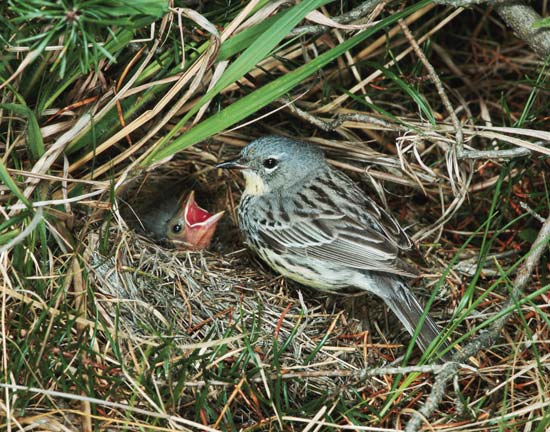
There is currently a recovery plan for Kirtland’s warbler, the aptly named Kirtland’s Warbler Recovery Plan. This plan has five main objectives: to develop and maintain 36,000 to 40,000 square acres for nesting by rotation cutting 140,000 square acres of jack pines, protecting warblers along their migration routes, reducing the main factors harming Kirtland’s warblers, monitoring breeding patterns to evaluate their response to habitat changes, and develop emergency measures to prevent extinction.
Kirtland’s Warblers aren’t the only species that need a large amount of space. Many other organisms are also evolved to live in the deep woods, and are unable to transition into other habitats. Habitat fragmentation, discontinuities in an organism’s environment, threaten not only Kirtland’s Warbler, but many other species we take for granted today.Sources:
.jpg)

Friday, March 4, 2016
Greenbriar
Greenbrier is a warm-season peren-
nial woody vine or shrub. The stems
are climbing with tendrils and tend
to form tangled masses. Within these tangled masses, or mottes, the indi- vidual vines may be more than 20 feet long. These mottes may become so intertwined and matted that they be- come virtually impenetrable to live- stock. Greenbrier leaves are deltoid
or heart-shaped, with new foliage emerging in the early spring. The new foliage is tender and succulent early, but soon toughens and develops a thick waxy cuticle. The young, tender shoots and stems make excellent forage for both wildlife and livestock. Greenbriar are a paIN IN THE BUTT to get out of your clothes,skin,hair. Anything really, They are sharp and can make open wounds on your body. Somehow dogs can walk straight through them without being bugged by it.

Photo creds to Diana!!!!
http://www.noble.org/global/ag/soils/greenbrier/greenbrier.pdf
to form tangled masses. Within these tangled masses, or mottes, the indi- vidual vines may be more than 20 feet long. These mottes may become so intertwined and matted that they be- come virtually impenetrable to live- stock. Greenbrier leaves are deltoid
or heart-shaped, with new foliage emerging in the early spring. The new foliage is tender and succulent early, but soon toughens and develops a thick waxy cuticle. The young, tender shoots and stems make excellent forage for both wildlife and livestock. Greenbriar are a paIN IN THE BUTT to get out of your clothes,skin,hair. Anything really, They are sharp and can make open wounds on your body. Somehow dogs can walk straight through them without being bugged by it.


Photo creds to Diana!!!!
http://www.noble.org/global/ag/soils/greenbrier/greenbrier.pdf
Wednesday, March 2, 2016
Beaver?
I fear that humans have essentially colonized nature. It certainly seems that way. My spot in the park is no longer an accurate representation of nature, rather it is the decaying remains of what it once was. By calling it a park we condemn nature to a glass casket, where its mutilated corpse can be put on display for the general public. Exploring my spot in this park is similar to conducting an autopsy; in no way does it give a sense of the capabilities in a living body, or what the experience of living is. But it gives an overview. A technical analysis that may prove to be slightly useful, but at the same time is extraordinarily depressing.
If my experience in the park is an autopsy, the cause of death is painfully obvious. Broken glass rests on the shore like blemishes on skin. A submerged tire sits stagnant in the river; a malignant tumor, killing its host. As if human presence wasn't already made totally clear, a brightly colored beach ball bobs in and out of the water, stuck on a fallen tree. I could ignore the broken glass. If I wasn't thinking about it, I would have looked right past the tire. But with every sway and bob in the water the ball flashed its bright colors and caught my eye. Nothing in the park could have even nearly resembled it. Hell, most of the colors on it didn't even exist 500 years ago! There was no ignoring it.
By far the most noticeable aspect of life in my spot was from the impact humans had made, but nature had left its own subtle marks too. Whether I should interpret them as some sort of last desperate struggle, or sign of a real formidable resistance to human takeover is something I haven't yet decided. The first sign of a natural organism I saw was just before I reached the shore to the river. The stump of some baby tree had been chewed to the core. Examining the small trees around it, I saw more teeth/claw marks. Despite never having actually run into these marks before, my past cartoon and TV experience helped me conclude that those were signs of a beaver.
Again relying on my media heavy experience, I looked for more signs of beavers. As I’ve mentioned previously about my spot, downed trees are very common. Just downstream, a few trees had fallen into the river, perhaps creating an already semi-completed dam. Extra sticks and plants seem to have been also brought there, suggesting that the beaver may have been turning it into some sort of shelter in addition to its dam. I plan to look for more beaver signs on my next trip.
Oaks in the Park
Some of the notable trees I saw were oak trees. An oak is a tree in the genus (group of species) Quercus (Latin for “oak tree”). Although the oak tree I saw was Quercus alba, the white oak, there are about six hundred extant (non-extinct) species of oaks today, many of which are native to Virginia and the eastern US.
In these dangerous modern times that prove such a risk for plants and animals of all varieties due to human intervention, how has the rag-tag group of Quercus trees fared? Pretty well! With the exception of notable outliers like Quercus hinckleyi and Quercus hintonii, almost all of the oaks found on the IUCN Red List are categorized as “of least concern.” With six hundred extant species, only having a few endangered ones on a planet with 16,000+ endangered species is a remarkable feat, and truly a sign of the humble oak’s resilient nature.
It makes sense, then, that in the creek’s barren landscape, the oak trees are the largest sign of life. And further, I hope they still are in the future—oaks have graced the Earth with their luscious presence for thousands of years, and I hope they lighten our days for thousands more to come.
Read more about oak trees at these links!
Identify your oak by its bark.
IUCN Red List
The History of the English Oak
History of Oak Trees
Subscribe to:
Posts (Atom)